Advanced Machine Learning with Python (Session 1 - Part 2)

Fernando Cervantes (fernando.cervantes@jax.org)

Materials

Open notebook in Colab View solutions

Convolutional Neural Network (CNN or ConvNet)

Convolution layers

The most common operation in DL models for image processing are Convolution operations.

2D Convolution

The animation shows the convolution of a 7x7 pixels input image (bottom) with a 3x3 pixels kernel (moving window), that results in a 5x5 pixels output (top).

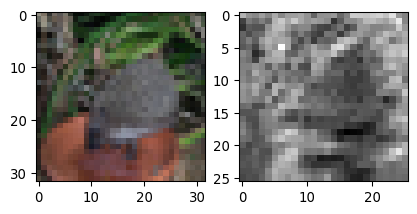
Exercise: Visualize the effect of the convolution operation
import torch.nn as nn

conv_1 = nn.Conv2d(in_channels=3, out_channels=1, kernel_size=7, padding=0, bias=True)

x, _ = next(iter(cifar_train_dl))

fx = conv_1(x)
print("Input:", type(x), x.dtype, x.shape, x.min(), x.max())
print("Output:", type(fx), fx.dtype, fx.shape, fx.min(), fx.max())
Input: <class 'torch.Tensor'> torch.float32 torch.Size([128, 3, 32, 32]) tensor(0.) tensor(1.)
Output: <class 'torch.Tensor'> torch.float32 torch.Size([128, 1, 26, 26]) tensor(-0.8468, grad_fn=<MinBackward1>) tensor(0.1861, grad_fn=<MaxBackward1>)

Warning

The convolution layer is initialized with random values, so the results will vary.

Exercise: Visualize the effect of the convolution operation

import matplotlib.pyplot as plt

plt.rcParams['figure.figsize'] = [5, 5]

fig, ax = plt.subplots(1, 2)
ax[0].imshow(x[0].permute(1, 2, 0))
ax[1].imshow(fx.detach()[0, 0], cmap="gray")
plt.show()

Important

By default, outputs from PyTorch modules are tracked for back-propagation.

To visualize it with matplotlib we have to .detach() the tensor first.

Exercise: Visualize the effect of the convolution operation
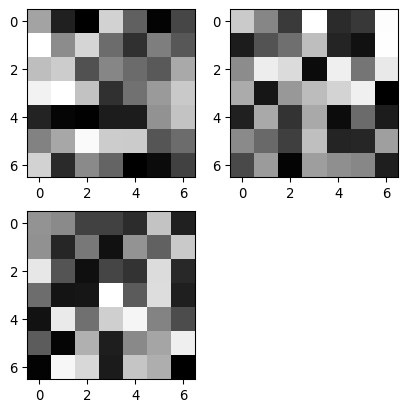
conv_1.weight.shape
torch.Size([1, 3, 7, 7])
fig, ax = plt.subplots(2, 2)
ax[0, 0].imshow(conv_1.weight.detach()[0, 0], cmap="gray")
ax[0, 1].imshow(conv_1.weight.detach()[0, 1], cmap="gray")
ax[1, 0].imshow(conv_1.weight.detach()[0, 2], cmap="gray")
ax[1, 1].set_axis_off()
plt.show()

Exercise: Visualize the effect of the convolution operation
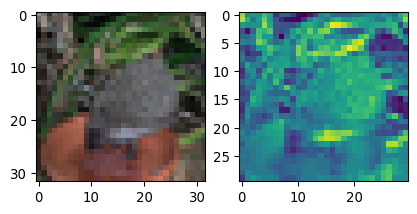
conv_1 = nn.Conv2d(in_channels=3, out_channels=1, kernel_size=3, padding=0, bias=False)

conv_1.weight.data[:] = torch.FloatTensor([
  [
    [
      [0, 0, 0],
      [0, 0, 0],
      [0, 0, 0],
    ],
    [
      [0, 0, 0],
      [0, 1, 0],
      [0, 0, 0],
    ],
    [
      [0, 0, 0],
      [0, 0, 0],
      [0, 0, 0],
    ],
  ]
])

Exercise: Visualize the effect of the convolution operation

fx = conv_1(x)

fig, ax = plt.subplots(1, 2)
ax[0].imshow(x[0].permute(1, 2, 0))
ax[1].imshow(fx.detach()[0].permute(1, 2, 0))
plt.show()

Experiment with different values and shapes of the kernel https://en.wikipedia.org/wiki/Kernel_(image_processing)

Exercise: Visualize the effect of the convolution operation

conv_1 = nn.Conv2d(in_channels=3, out_channels=1, kernel_size=3, padding=0, bias=False)

conv_1.weight.data[:] = torch.FloatTensor([
  [[[0, -1, 0], [-1, 5, -1], [0, -1, 0]],
   [[0, 0, 0], [0, 0, 0], [0, 0, 0]],
   [[0, 0, 0], [0, 0, 0], [0, 0, 0]]]
])

fx = conv_1(x)

fig, ax = plt.subplots(1, 2)
ax[0].imshow(x[0].permute(1, 2, 0))
ax[1].imshow(fx.detach()[0, 0], cmap="gray")
plt.show()
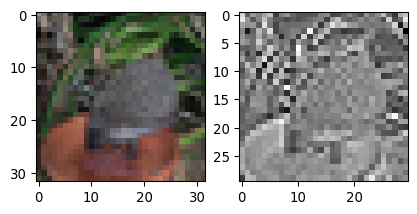
Experiment with different values and shapes of the kernel https://en.wikipedia.org/wiki/Kernel_(image_processing)

Exercise: Visualize the effect of the convolution operation

conv_1 = nn.Conv2d(in_channels=3, out_channels=1, kernel_size=3, padding=0, bias=False)

conv_1.weight.data[:] = torch.FloatTensor([
  [[[1, 0, -1], [1, 0, -1], [1, 0, -1]],
   [[1, 0, -1], [1, 0, -1], [1, 0, -1]],
   [[1, 0, -1], [1, 0, -1], [1, 0, -1]]]
])

fx = conv_1(x)

fig, ax = plt.subplots(1, 2)
ax[0].imshow(x[0].permute(1, 2, 0))
ax[1].imshow(fx.detach()[0, 0], cmap="gray")
plt.show()
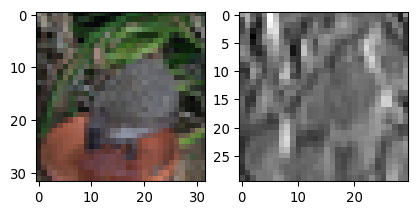
Experiment with different values and shapes of the kernel https://en.wikipedia.org/wiki/Kernel_(image_processing)

Exercise: Implement and train the LetNet-5 model with PyTorch
lenet_clf = nn.Sequential(
    nn.Conv2d(in_channels=3, out_channels=6, kernel_size=5, bias=True),
    nn.ReLU(),
    nn.MaxPool2d(kernel_size=2),
    nn.Conv2d(in_channels=6, out_channels=16, kernel_size=5, bias=True),
    nn.ReLU(),
    nn.MaxPool2d(kernel_size=2),
    nn.Flatten(),
    nn.Linear(in_features=16*5*5, out_features=120, bias=True),
    nn.ReLU(),
    nn.Linear(in_features=120, out_features=84, bias=True),
    nn.ReLU(),
    nn.Linear(in_features=84, out_features=100, bias=True),
)

Note

Pooling layers are used to downsample feature maps to summarize information from large regions.

Exercise: Implement and train the LetNet-5 model with PyTorch

y_hat = lenet_clf(x)

type(y_hat), y_hat.dtype, y_hat.shape, y_hat.min(), y_hat.max()
(torch.Tensor,
 torch.float32,
 torch.Size([128, 100]),
 tensor(-0.1309, grad_fn=<MinBackward1>),
 tensor(0.1939, grad_fn=<MaxBackward1>))

Exercise: Implement and train the LetNet-5 model with PyTorch

import torch.optim as optim

num_epochs = 10
train_loss = []
val_loss = []

if torch.cuda.is_available():
  lenet_clf.cuda()

optimizer = optim.SGD(lenet_clf.parameters(), lr=0.01)
loss_fun = nn.CrossEntropyLoss()

for e in range(num_epochs):
  train_loss_avg = 0
  total_train_samples = 0

  lenet_clf.train()
  for x, y in cifar_train_dl:
    optimizer.zero_grad()

    if torch.cuda.is_available():
      x = x.cuda()
    
    y_hat = lenet_clf( x ).cpu()

    loss = loss_fun(y_hat, y)

    train_loss_avg += loss.item() * len(x)
    total_train_samples += len(x)

    loss.backward()

    optimizer.step()

  train_loss_avg /= total_train_samples
  train_loss.append(train_loss_avg)

  val_loss_avg = 0
  total_val_samples = 0

  lenet_clf.eval()
  with torch.no_grad():
    for x, y in cifar_val_dl:
      if torch.cuda.is_available():
        x = x.cuda()
      
      y_hat = lenet_clf( x ).cpu()
      loss = loss_fun(y_hat, y)

      val_loss_avg += loss.item() * len(x)
      total_val_samples += len(x)

  val_loss_avg /= total_val_samples
  val_loss.append(val_loss_avg)

  print(f"[Epoch {e}] Training loss: {train_loss_avg}, validation loss: {val_loss_avg}")
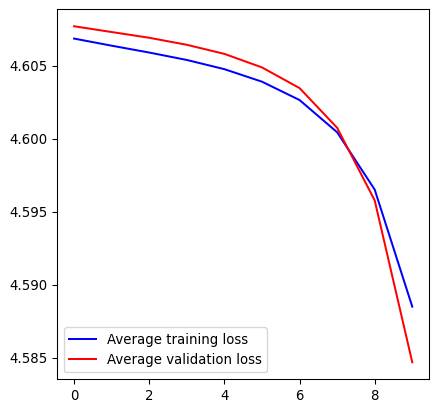
[Epoch 0] Training loss: 4.606845104980469, validation loss: 4.607688095855713
[Epoch 1] Training loss: 4.606358392333984, validation loss: 4.6072938385009765
[Epoch 2] Training loss: 4.6058888946533205, validation loss: 4.606900331115723
[Epoch 3] Training loss: 4.605380735778809, validation loss: 4.606419638061523
[Epoch 4] Training loss: 4.604751779937744, validation loss: 4.605797494506836
[Epoch 5] Training loss: 4.603894428253174, validation loss: 4.604871366882324
[Epoch 6] Training loss: 4.6026390899658205, validation loss: 4.60345597076416
[Epoch 7] Training loss: 4.600434151458741, validation loss: 4.600740374755859
[Epoch 8] Training loss: 4.596508473205566, validation loss: 4.59577003326416
[Epoch 9] Training loss: 4.588493662261963, validation loss: 4.584687497711181

Exercise: Implement and train the LetNet-5 model with PyTorch

plt.plot(train_loss, "b-", label="Average training loss")
plt.plot(val_loss, "r-", label="Average validation loss")
plt.legend()
plt.show()

Exercise: Implement and train the LetNet-5 model with PyTorch

from torchmetrics.classification import Accuracy

lenet_clf.eval()

val_acc_metric = Accuracy(task="multiclass", num_classes=100)
test_acc_metric = Accuracy(task="multiclass", num_classes=100)
train_acc_metric = Accuracy(task="multiclass", num_classes=100)

with torch.no_grad():
  for x, y in cifar_train_dl:
    if torch.cuda.is_available():
      x = x.cuda()
    y_hat = lenet_clf( x ).cpu()
    train_acc_metric(y_hat.softmax(dim=1), y)

  train_acc = train_acc_metric.compute()

  for x, y in cifar_val_dl:
    if torch.cuda.is_available():
      x = x.cuda()
    y_hat = lenet_clf( x ).cpu()
    val_acc_metric(y_hat.softmax(dim=1), y)

  val_acc = val_acc_metric.compute()

  for x, y in cifar_test_dl:
    if torch.cuda.is_available():
      x = x.cuda()
    y_hat = lenet_clf( x ).cpu()
    test_acc_metric(y_hat.softmax(dim=1), y)

  test_acc = test_acc_metric.compute()

print(f"Training acc={train_acc}")
print(f"Validation acc={val_acc}")
print(f"Test acc={test_acc}")

train_acc_metric.reset()
val_acc_metric.reset()
test_acc_metric.reset()
Training acc=0.014574999921023846
Validation acc=0.01510000042617321
Test acc=0.013700000010430813